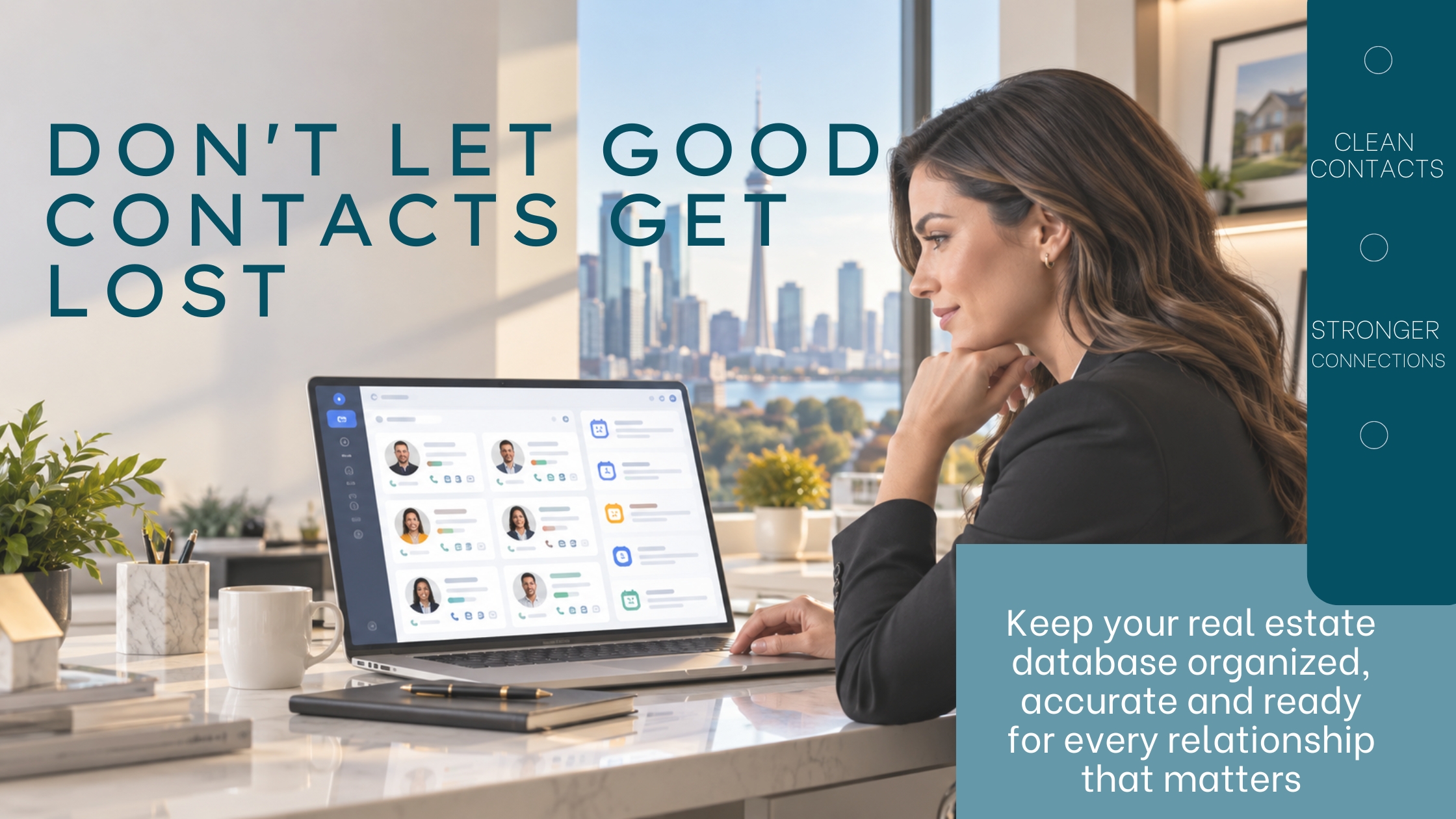
A Realtor’s contact database rarely becomes messy overnight.
Instead, it happens gradually.
A new contact arrives through a referral. Someone registers at an open house. An old spreadsheet gets imported. A former client changes their phone number. Another person enters the database twice because they used a different email address.
Before long, one person has three records, important details live inside scattered notes, and outdated information makes it harder to know which record you can trust.
That might sound like a simple administrative problem. However, poor real estate contact management can eventually become a business problem.
After all, your database isn’t just a collection of names and phone numbers. It represents relationships you’ve built over time—and many of those relationships may lead to future referrals, repeat business and new opportunities.
Why Contact Management Matters in Real Estate
Real estate is highly relationship-driven.
The National Association of REALTORS® reported that in 2025, the typical REALTOR® earned 28% of their business from repeat clients and another 22% from referrals from past clients and customers.
Explore NAR’s 2026 Member Profile findings
Those numbers highlight an important point: your existing network has long-term business value.
Yet staying connected becomes difficult when you can’t rely on the information in your own database.
Imagine wanting to reconnect with a past client but finding two different phone numbers. Or perhaps you want to invite local contacts to an event, but your records don’t clearly show where they live.
Even worse, you may send the same person the same communication twice because duplicate records exist.
Clean contact data gives you something every Realtor needs: confidence that the right information is attached to the right relationship.
Why Real Estate Contact Lists Get Messy
Most database problems don’t happen because an agent neglects their contacts.
They happen because information enters the business from many different places.
A Realtor may collect contacts through:
- Open houses
- Referrals
- Networking events
- Website forms
- Previous transactions
- Phone calls and text messages
- Community events
- Imported spreadsheets
- Social media
Each source can capture information differently.
One record might contain a full name and email address. Another has only a phone number. Meanwhile, a business card may provide valuable professional details that never make it into the CRM.
Without a consistent process, small inconsistencies accumulate.
Eventually, the contact list becomes harder to search, segment and use.
The Hidden Cost of a Disorganized Contact Database
Duplicate records are the most obvious problem, but they’re far from the only one.
You lose context
A name and phone number tell you who someone is. They don’t necessarily tell you why the relationship matters.
Perhaps you met someone at an open house two years ago. Maybe they’re a past client who bought an investment property. Another person might be a mortgage professional who regularly sends referrals.
Without context, future outreach becomes generic.
Follow-ups become easier to miss
A contact database becomes much more valuable when it helps you maintain relationships.
If important information sits in different records or apps, however, you may miss an opportunity to reconnect.
Marketing becomes less relevant
Suppose you want to communicate with a particular group within your network.
Clean, organized information helps you select the right people. Poor data makes segmentation less reliable and can lead to irrelevant outreach.
Duplicate communication can damage the experience
Sending someone the same email twice doesn’t create a great impression.
Likewise, contacting a person using outdated or conflicting information can make an otherwise professional business look disorganized.
Eventually, you stop trusting your own database
This may be the biggest problem.
Once agents stop trusting their records, they often begin creating workarounds—personal spreadsheets, phone notes, separate lists or reminders.
Those workarounds create even more fragmentation.
The cycle continues.
What Does Clean Real Estate Contact Management Look Like?
A clean database doesn’t need to contain every possible detail about every person.
Instead, it should contain useful, current and organized information that helps you understand the relationship.
Here are the fundamentals.
1. Maintain One Reliable Record Per Person
Ideally, each person should have one primary contact record.
Before creating a new contact, check whether that individual already exists in your system. If duplicates appear, review the information carefully and consolidate it where appropriate.
Duplicate management is a common contact-management need. For example, Google Contacts includes dedicated functionality for identifying and merging duplicate contact records.
See Google’s guidance on managing duplicate contacts
The same principle applies to a real estate database: one person should have one reliable history whenever possible.
2. Capture More Than a Name and Phone Number
Contact details are useful, but context makes them valuable.
Depending on the relationship, useful information could include:
- How you met
- Relevant location
- Property interests
- Important notes
- Previous relationship or transaction
- Preferred communication method
- Relevant dates
- Contact category
- Appropriate follow-up frequency
Don’t collect information simply because your CRM provides a field for it. Capture details that can help you provide more relevant service later.
3. Organize Contacts by Relationship Value
Not every person in your network requires the same level of attention.
For example, a past client who regularly sends referrals may warrant more frequent personal communication than someone you met once at a networking event.
Creating meaningful contact categories can help Realtors prioritize relationship-building.
The goal isn’t to decide who matters and who doesn’t.
Instead, categorization helps answer:
Who should I stay particularly close to, and how often should I connect with them?
That turns a static address book into a relationship-management tool.
4. Keep Information Consistent
Small formatting differences can create bigger problems later.
One contact might be entered as “Robert Smith,” another as “Bob Smith.” A phone number may appear in several formats. Locations might use different abbreviations.
Consistency becomes particularly important when you want to search, filter or segment your database.
Therefore, establish simple standards for the information you use regularly.
For example, decide how your team records names, phone numbers, locations and other key fields.
The cleaner the input, the more useful the database becomes later.
5. Update Information When You Learn Something New
Contact management shouldn’t become an annual cleanup project.
Instead, make updating records part of everyday activity.
When someone provides a new phone number, update it.
If a contact moves, change their address or location details.
After an important conversation, add the relevant context.
When a relationship changes, update its category.
Small updates made consistently prevent large cleanup projects later.
Make Database Maintenance a Habit, Not a Project
Many Realtors wait until their contact list becomes difficult to use before cleaning it.
Then comes the dreaded database cleanup.
Duplicates get merged. Old information gets removed. Missing details get added.
Everything looks great—for a while.
However, without better daily habits, the same problems gradually return.
A more sustainable approach is to build contact cleanliness into the normal workflow.
For example, you might:
Check before creating. Search for an existing record before adding someone new.
Update while the information is fresh. Don’t wait months to add something important you learned today.
Review duplicates regularly. Address them before they multiply.
Standardize important fields. Use consistent formats and categories.
Schedule periodic reviews. Occasionally check records that haven’t changed for a long time.
The objective isn’t a perfectly spotless database.
It’s a database you can trust and use.
Clean Contacts Make Better Outreach Possible
Database organization becomes particularly valuable when you want to stay connected with your network.
Imagine having 1,000 contacts but knowing very little about them.
Now compare that with 1,000 organized contacts where you can identify past clients, referral partners, important relationships and people who may appreciate particular types of communication.
The second database gives you far more possibilities.
You can create more relevant outreach, reconnect with important relationships and avoid sending every message to everyone.
In other words, good real estate contact management improves more than organization.
It supports better relationship marketing.
Why This Matters More as Your Business Grows
A messy database of 50 contacts may still be manageable.
A disorganized database containing hundreds or thousands of people becomes much harder to work around.
More importantly, the value of an organized network can grow over time.
NAR’s latest Member Profile reinforces that relationship effect. In 2025, repeat clients accounted for 28% of the typical REALTOR®’s business, while referrals from past clients and customers accounted for another 22%.
Experienced agents showed an even stronger reliance on established relationships. NAR reported that repeat business represented about half of the customer pipeline for agents with more than 16 years of experience.
Your database, therefore, shouldn’t become less useful as your career progresses.
It should become one of your most valuable business assets.
From a Contact List to a Relationship Network
This is where there is an important difference between simply storing contacts and actually managing relationships.
A contact list answers:
“Who do I know?”
A good contact-management process goes further:
“Who should I stay connected with?”
“What is my relationship with them?”
“When should I reach out again?”
“How can I make that outreach relevant?”
Those questions shift the focus away from database administration and toward long-term relationship building.
And that’s ultimately what a Realtor’s network should support.
How Realty Space Helps Realtors Manage Their Contacts
Realty Space treats Contacts differently from Leads.
A lead represents a potential business opportunity. A contact represents someone within the Realtor’s broader network—such as a client, past client, professional connection or another relationship worth maintaining.
With Realty Space Contact Management, Realtors can organize those relationships in one place and categorize contacts as Silver, Gold or VIP based on the importance of the relationship.
Agents can also establish an appropriate connection frequency—such as monthly, quarterly, semi-annually or annually—to create a more deliberate approach to staying in touch.
Explore Realty Space Contact Management
Rather than treating the database as a static address book, this approach helps turn it into a network that agents can actively manage.
Because the real value isn’t simply knowing how many contacts you have.
It’s knowing which relationships matter and making sure they don’t quietly disappear from your business.
Clean contact records aren’t exciting.
But the opportunities they support certainly can be.
Accurate information makes it easier to find people, understand relationships, segment outreach and maintain meaningful connections over time.
So, don’t wait until your database becomes something you avoid opening.
Remove duplicates. Add useful context. Keep important details current. Organize relationships meaningfully and create a routine for maintaining the information.
A clean database doesn’t just help you stay organized.